
A very difficult book to read.
That’s the first sentence I want to put down for this one. And I don’t mean ‘difficult’ in the way of dense, jargon-heavy, academic-textbook reads. Taleb actually writes in a fairly accessible way. It is difficult because the book just refuses to let you stay comfortable in your own head. Every other page, you find yourself questioning some neatly constructed story you have been telling yourself about your life, your work, your good decisions, your lucky breaks.
I picked this book up months ago. It sat on my nightstand and stared at me for weeks. I’ve recently been diagnosed with a potential fuchs dystrophy (its a damaged cornea) and I told myself that it was the main reason that I was not reading enough. But actually, that is not true. I would open it, read a few pages, get my mind tied into knots, put it down. Repeat. Eventually I just powered through.
—————————————————————————————————————————————————————————
FOOLED BY RANDOMNESS
~ by Nassim Nicholas Taleb ~
—————————————————————————————————————————————————————————
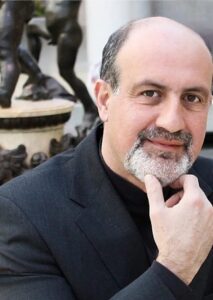 A bit about the man himself, because I think it adds to how you read this book. Taleb was a derivatives trader on Wall Street for many years. He made his money – and apparently a lot of it – betting that the world is far more random than people care to admit, and that the rare, unpredictable events end up mattering more than all the ‘predictable’ ones we obsess over daily. He is a mathematician, statistician, philosopher and also – and I say this with affection – a bit of a grump. He has very little patience for economists, journalists, MBAs and most people who claim certainty about things they cannot possibly know. Some of his commentary is so direct it’s almost rude. I found myself laughing out loud at parts – sarcasm is my preferred form of humor 🙂
This is also the first book in his ‘Incerto’ series – which loosely translates to ‘uncertainty’. Fooled by Randomness came before the very famous The Black Swan.
Okay, let’s dive in.
THE LUCKY FOOL
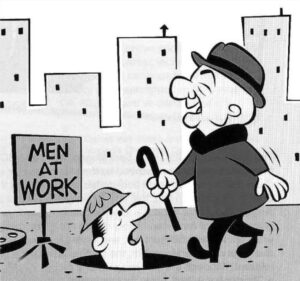 This is the central character of the book. Not a real person, but a type. The Lucky Fool is someone who has done extraordinarily well in life – a fortune in trading, a meteoric career, a string of wins – and has decided that the reason for all of it is their own brilliance.
Taleb argues, with mathematical rigour and equal sarcasm, that a healthy chunk of these people are simply the lucky end of a probability distribution. If you have ten thousand monkeys typing on ten thousand typewriters, somewhere in there will be a ‘genius’ monkey that has typed a near-perfect sentence. Does that monkey deserve a book deal? Probably not.
The discomfort I felt while reading this section was real. We all want to believe our successes are because of how smart we are, how hard we worked, how brilliant our judgment is. Taleb (not so (Image is from the internet) gently) reminds us – that maybe you were just at the right place at the right time, and survivorship bias did the rest.
I have been guilty of this. I have constructed beautiful narratives about my careers (yes, plural), in which every choice I made is presented as wise and intentional, when really, the fork in the road took itself!
ALTERNATIVE HISTORIES
This was, by far, my favourite concept in the book.
Taleb asks us to think of life as one path among very many possible paths. The version that actually played out is just one outcome out of an enormous tree of possibilities. He calls these the ‘alternative histories’.
Think of a man who plays Russian roulette for a million dollars. He pulls the trigger, the chamber is empty, he walks away rich. We celebrate him. He’s in the magazines. His ‘investment philosophy’ is studied.
But Taleb says – wait. There were six possible outcomes, and in five of them, the man is dead. Just because we are looking at the version where he survived, does not mean what he did was smart.
I read this and immediately thought about all the founders, traders, leaders we put on pedestals. Are they really visionaries? Or are they the surviving member of a much larger group of people who took similar bets and didn’t make it? We never get to interview the dead ones.
This idea – of holding all the alternative histories in your head while evaluating an outcome – is so simple and so powerful. I’ve started using it in some of my own decision making. ‘Yes, this worked out. But of all the ways this could have gone, what fraction would have ended this well?’
A bit of an uncomfortable question. And therefore, a good one.
SURVIVORSHIP BIAS
Closely linked to the above. We only ever see the winners.
Walk into any bookstore and look at the business section. ‘How I built this’. ‘Habits of CEOs’. ‘What successful people do differently’. Notice anything? They are all written by, or about, the survivors.
Where are the books written by people who tried the same thing, did everything ‘right’, and still failed? They don’t exist. They don’t get published. Nobody wants to read them.
This means our entire understanding of ‘what works’ is built on a sample that is hopelessly skewed. Taleb’s point is that if you really want to understand whether a strategy works, you have to look at everyone who tried it – not just the ones still standing. And you almost never have access to that data.
I kept thinking about the parenting books, advice books, career books I have been reading. Every single one of them suffers from this. Take it all with a healthy fistful of salt.
THE TYRANNY OF RARE EVENTS
This is where it gets a little technical, but stay with me.
Taleb spends a fair bit of the book explaining why averages and ‘expected outcomes’ can be deeply misleading. The core idea – sometimes events are very rare but very large in impact. A trader can earn small consistent profits for ten years and then lose everything in a single bad week. On average his returns might look great, until that week. On a graph he is a star. Until he isn’t.
The world, Taleb says, is built like that. Most of the variation that really shapes our lives comes from a few enormous, unpredictable events – not from the steady noise we obsess over every day.
I happened to be reading this section on a day the markets had one of their dramatic moves. My WhatsApp groups & YT feeds were on fire. ‘What does this mean?’ ‘Should we be worried?’ ‘What is the strategy now?’ . Taleb’s point sat in the back of my head – maybe today is not the signal. Maybe today is just noise. The real, big, life-shaping move – we won’t see it coming, and it won’t land on a Tuesday afternoon when everyone is looking.
NOISE vs SIGNAL
Speaking of which.
Taleb dedicates a delicious chapter to news. He has a wonderful set-up of a dentist who, if he checked his portfolio every minute, would feel constantly miserable from all the small fluctuations – even though over a year his returns are excellent. The same dentist, if he checks the portfolio once a year, lives a happy life.
The math behind this is real. The shorter the window you observe, the more noise relative to signal. Most of what we read every day, scroll through, react to, debate at the dinner table – is noise and largely for human engagement or entertainment. The real signal is buried somewhere underneath and is best seen from a distance and over a period of time.
STOICS, SCEPTICS AND SOLON
Just when you think the book is going to be all about probability and trading, Taleb turns to philosophy. And this is where I really fell in love, obviously.
He goes back to the Stoics – Seneca, Marcus Aurelius. He talks about Solon’s warning to Croesus, the famously rich king – that no man should be called happy until he is dead, because the gods are jealous and luck is fickle. He brings in Karl Popper and the lovely idea that we can never really prove a theory true; we can only fail to prove it false.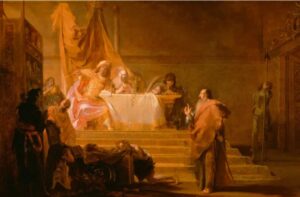
The thread tying it all together – wisdom, real wisdom, is in large part the practice of being humble in the face of uncertainty. Of not mistaking your good fortune for your brilliance. Of being suspicious of your own confidence.
I underlined a lot in this section!
A WORD ON TALEB’S STYLE
I should warn you that Taleb is not warm or nurturing in his writing style. He digresses – quite a lot. He insults large groups of professionals (sometimes hilariously, sometimes a bit gratuitously). He drops in references to Greek philosophers and obscure mathematicians like every reader has of course read them before – so you have to be patient and google a lot.
If you are someone who needs a book to be ‘nicely organised’ – like I tend to – this might frustrate you. The chapters often feel like a bunch of essays loosely strung together rather than a tight argument building from A to Z. I remember thinking – why wasn’t this edited better!
But I think you have to take the man as he is. He is not selling you a method. He is sharing a worldview. And frankly, I don’t think he really cares whether you read it or not.
WHAT I AM TAKING AWAY
A few things have shifted for me after this book.
One – I am much more sceptical of confident people. Including, and especially, myself. When I find myself certain about how something will play out, I now ask – what would the alternative histories look like? What am I not seeing?
Two – I am learning to differentiate between ‘this turned out well’ and ‘this was a good decision’. They are not the same thing. A good decision can have a bad outcome. A bad decision can have a great outcome. Process and result are very different things with a lot of randomness in between. Judging yourself or anyone else only by results is a losing game.
Three – I am quieter on the daily news. I watch it all but I try to react less to it. The world is mostly noise, punctuated by rare, unpredictable signal. And I am terrible at telling the two apart in the moment. But awareness is the first step.
Four – I am a little more humble. Just a little. About my career, my choices, my life so far. Some of it is hard work. A lot of it, if I am being very honest, is being born to the right family, finding the right people, joining the right firm at the right time, being in the right place with supportive people etc. The Lucky Fool inside me has been a bit chastened. And that is not a bad thing!
Will I read this book again? Yes – but only after a VERY long break. Some books need digesting in stages.
If you are willing to have an uncomfortable conversation with yourself about how much of your life is your own making, and how much is just – well, randomness – then go for it.
Best,
Ruta
Whoa .. thats some food for thought!