
I wish I had read this book sooner. There are so many ‘pearls of wisdom’ in this book – and what’s even more wonderful is that they are laid out in a very practical manner and often with examples.
Zero To One is a business book, I bought it because I wanted to get information on how to build something and build it well. This year I began a new venture; I am what they call a first-generation entrepreneur – and this book was recommended by pretty much everyone for a ‘startup founder’. Frankly, I don’t see myself as a ‘Startup Founder’ yet.
ZERO TO ONE
~ by Peter Thiel ~
 The first thing to understand is that Peter Thiel is one of the most successful founders – he founded PayPal and then Palantir and has made many investments along the way which became very profitable. His companies are valued in billions of dollars. So when he says something – people listen very carefully. His business acumen and a knack for spotting multi-billion-dollar ideas and building them successfully – is matched by his ability to distil this knowledge in writing. What a gift for all of us readers.
“The paradox of teaching entrepreneurship is that such a formula necessarily cannot exist; because every innovation is new and unique, no authority can prescribe in concrete terms how to be innovative.”
WHAT TO BUILD?
A lot of people would like to be Founders. Many of those have networks that can help. Some even have the resources to give it a proper shot. However, very few have an idea about what to build. So you want to be a successful entrepreneur – but doing what? That is the most difficult question – and people often hide it under a lack of money, time, skill, energy, access – and all that.
Well. Zero To One is probably one of the very few books (at the time it came out) that addressed that question. What to build? Where are these secret high potential ideas that can be very successful hiding?
“Successful people find value in unexpected places.”
Peter talks about two areas where these ‘secrets’ might be hiding – and it is so beautifully simple. One – “What secrets is nature not telling you?” – Two – “What secrets are people not telling you?”. He classifies these two areas to give direction to an aspirant that if they are looking for a big idea, this is how they can start to look for it. Nature’s secrets are abundant but would require a significant amount of scientific study to uncover them. People secrets are more psychology, and you might not need a PhD to uncover one of these – think about Facebook – it was built on the idea that people want to be friends with selective people and that we all want validation, a ‘like’ here, a ‘like’ there and cool photos to show off. It wasn’t rocket science and look at where it is today.
So, what do to if you find a secret?
“Unless you have perfectly conventional beliefs. It’s rarely a good idea to tell everybody everything that you know”, he says.
AN EXERCISE IN THINKING
“This book is about the questions you must ask and answer to succeed in the business of doing new things: what follows is not a manual or a record of knowledge but an exercise in thinking.”
Thiel says that this book is not meant to be a manual of what to do and what not to do – but in my opinion it comes pretty close to being a real good one. That being said, it is definitely not prescriptive (and can’t be) – it is as he says – an exercise in ‘thinking’.
While we all believe that we ‘think’ a lot – we probably need to revisit that notion. Thinking is not an easy process, it requires sidestepping those devils called distraction, pre conceived notions, self confirmation-biases, unsolicited opinions and so on. Thinking requires discipline and practice. And consistency. This book provides a fabulous framework for thinking.
Thiel poses a very provocative question to help you kick start the thinking process of finding a secret idea: “What important truth do very few people agree with you on?”
I had to put the book down at this point – and give it some real thought. One of my observations was also that it was hard to answer this question – because we agree too much with everything. It’s sad, but the truth probably is that we’ve forgotten how to think contrarian thoughts.
And frankly – if you can’t answer this question he poses, then you probably don’t have anything unique to build. It can’t be a 0 to 1 story.
WHY ARE WE LIKE THIS?
There’s this section in the book about students that was very though provoking
“By the time a student gets to college, he’s spent a decade curating a bewilderingly diverse resume to prepare for a completely unknowable future. Come what may, he’s ready – for nothing in particular.”
We’ve probably become a generation of people optimizing for optionality. We keep all doors open. We hedge our bets. We curate diverse resumes. And in doing so, we become what is popularly known as ‘average’.
Thiel calls this “indefinite optimism” – the belief that the future will be better but we have no idea how, so we better keep all our options open. This ‘way of being’ has taken a hold over us as some of the more common hardships are no longer around to push us and challenge us. We’re comfortable, pay checks are easier and everything will be just fine. Progress without planning – or what we call ‘evolution’.
Just take a look at the number of family offices – people managing money in diversified portfolios so it keeps growing reasonably and avoids any major mishap.
Thiel observes this phenomenon and calls it indefinite optimism.
“In an indefinite world, people actually prefer unlimited optionality; money is more valuable than anything you could possibly do with it.”
Why spend money building something that might not work because who knows what will happen? It’s better to just cruise – or so we think.
Thiel argues that we need more ‘definite optimism’ in our thinking.
An unshakeable belief, that we can build the future and make it turn out the way it should be. And in that we invest money, because money is a means to an end. It was always meant to be a means to an end. Not the end itself.
Imagine for a second that you have 50 crores in your bank account and 90-100 days left to live. What would you do?
“You can have agency not just over your own life but over a small and important part of the world. It begins by rejecting the unjust tyranny of Chance.”
This is obviously easier said than done – and this blog or the book is not meant to cause any decisions that are not thought through financially.
But if it is only courage that you are lacking, then please think again.
“Courage is in even shorter supply than genius.”
0 to 1 vs 1 to n
This is the central thesis of the book.
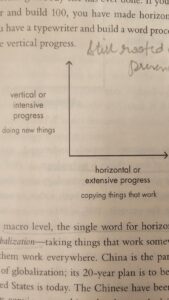 Going from 0 to 1 means creating something entirely new. Going from 1 to n means copying something that works. And because ‘copying’ is not a good word in common parlance, people say ‘scaling’.
There are some principles of going from 0 to 1 that Thiel talks about. These principles are based on years of experience and also observations of real-life cases. Thiel cites many examples along the way that you will recognize and I am sure that some of the markers he provides will surprise you – and make you wonder why you didn’t see it in the first place.
The following 8 went into my little notebook of learning.
- “Proprietary technology should be atleast 10 times better than it’s closest substitute in an important dimension.”
- “Network effects can be powerful; but you’ll never reap them unless your product is valuable to it’s very first users when the network is necessarily small.”
- “A good startup should have the potential for great scale built into it’s first designs.”
- “A company has a monopoly on its own brand by definition, so creating a strong brand is a powerful way to claim a monopoly.”
- “The perfect target market for a startup is a small group of particular people concentrated together and served by few or no competitors.”
- “The most successful companies make the core progression-to first dominate a specific niche and then scale to adjacent markets -a part of their founding narrative.”
- “If you can’t beat a rival, it might be better to merge.”
- “Sales matters just as much as the product.”
CAN YOU BE ENTREPRENEURIAL WORKING FOR A LARGE COMPANY?
No.
I used to think that you can – but the truth is you cannot.
“It’s hard to develop new things in big organizations, and it’s even harder to do it by yourself. Bureaucratic hierarchies move slowly, and entrenched interests shy away from risk. In the most dysfunctional organizations, signaling that work is being done becomes a better strategy for career advancement than actually doing work (if this describes your company, you should quit now.)”
There are other important factors to why this is not possible –
One – is that single-minded focus and drive – which is hard to cultivate and maintain in large organizations. There will always be something that takes you away from a big idea because you are not in charge of the narrative. But that said – you might still rough it out and keep going perhaps if you have a ‘Godfather’.
Two – and a big one – is the comfort of a pay check no matter what. Money is a very powerful force and it’s hard to pretend otherwise. Everything is different when you have to ‘hustle’ to get paid. It creates an urgency you cannot manufacture artificially.
And finally – it is the fact that you need a LOT of room to fail rapidly – but also without having to explain too much. And that is simply not possible in a large firm. Most start-up’s are expected to fail and so it does take the pressure off.
IS COMPETITION NECESSARY?
Most of us are taught from childhood that competition is good. Competition makes us better. Competition drives innovation.
Thiel says, “Competitive markets destroy profits…In the real world, every business is successful exactly to the extent that it does something that others cannot.”
Why do we glorify competition? Because it gives us a clear benchmark and we can measure ourselves against others. Thiel recommends a different approach, and that is to avoid competition as far as possible.
“Rivalry causes us to overemphasize old opportunities and slavishly copy what has worked in the past.”
When we are competing, we get so caught up in the battle that we forget to ask whether we’re fighting for something worth having.
“All happy companies are different: each one earns a monopoly by solving a unique problem. All failed companies are the same: they failed to escape competition.”
He also provides the sobering advice that: “If you can’t beat a rival, it might be better to merge.”
THE UNCOMFORTABLE TRUTH
Not everyone can create. Scaling is possible – but to be able to see something that does not exist – that’s not easy.
“It is true that every great entrepreneur is first and foremost a designer.”
Designers of their future. Designers of their companies. Designers of small, important parts of the world.
This book made me look at founders who go from 0 to 1 differently. These are people who saw something that didn’t exist – they brought something new, fresh and strange into this world. That is something worth aspiring for.
Now – take a minute – and think about someone trying to build a personal brand – not a company or a product – but their own brand. Now re-read this blog again and tell me what you think? My guess is that all of it will apply just the same.
I think everybody should read this book. Everybody should attempt to think differently. And try to build something fresh and strange in this lifetime we’ve been given.

Best,
Ruta